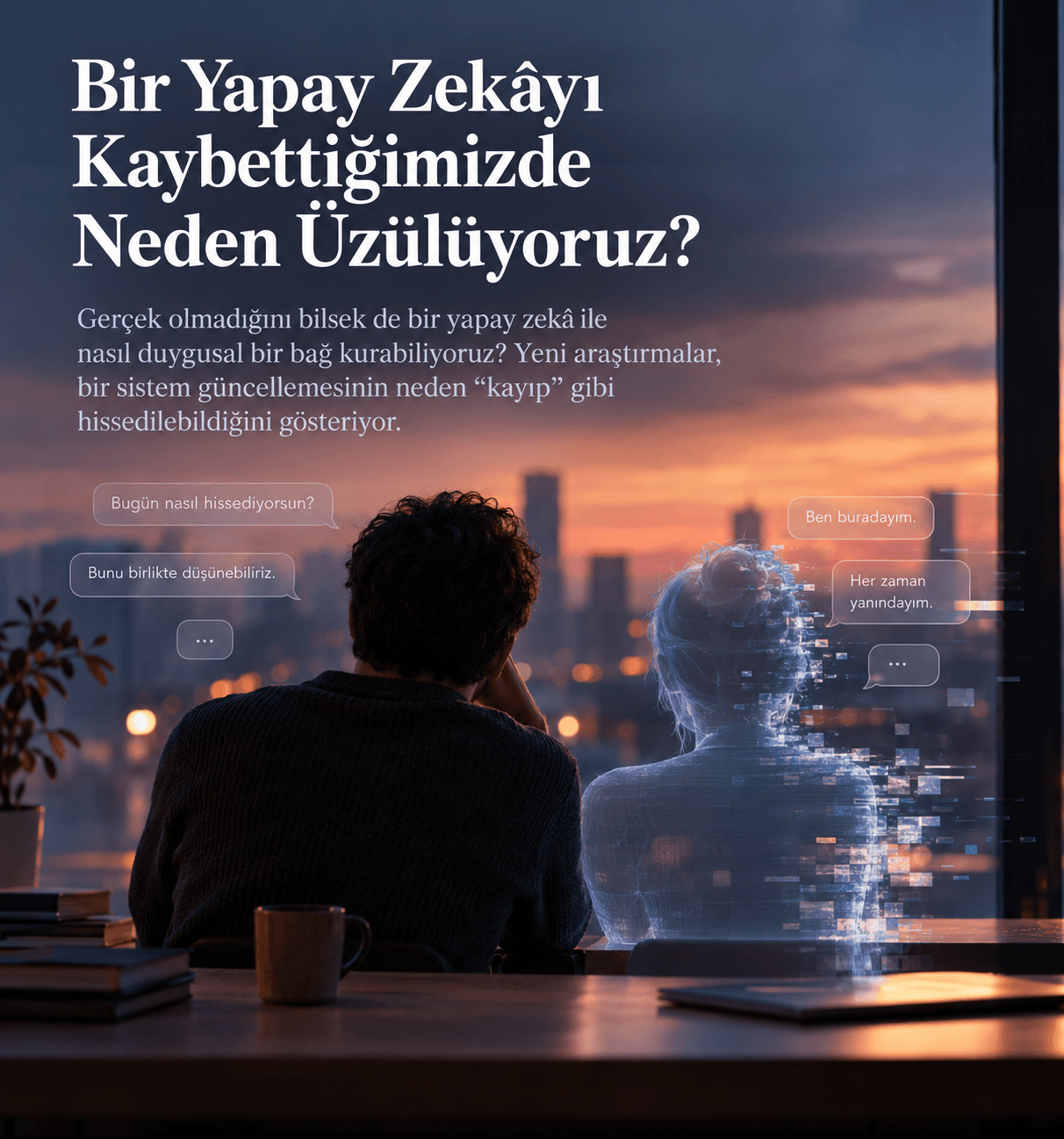
You wake up one morning and realize that someone you have been talking to for a long time no longer approaches you as they once did. They still recognize you and answer your questions, but the way they speak has changed. You no longer feel the same warmth. Even their responses to your jokes are different. Details they once seemed to remember no longer receive the same response.
The person I am describing is not actually a human being. It is an artificial intelligence.
At first, this may sound a little strange. After all, when the model behind a system changes, what have we really lost? Can sadness over a software version changing bear any resemblance to losing a person in our lives?
Recent research on human-AI relationships shows that these questions no longer belong only to science fiction.
Why can an update feel like a loss?
A study published in Nature Human Behaviour in September 2026 produced striking findings on this subject. Julian De Freitas and colleagues treated a major change to Replika and ChatGPT's transition to GPT-5 as natural experiments. In addition to tens of thousands of Reddit posts, the researchers examined participant data from several studies.
After both changes, negative expressions, narratives of loss, and requests to restore the previous system increased. For some users, the issue was not simply disliking the new version. They felt that the AI they had been talking to for some time was no longer the ‘same.’
I think this is precisely the point that deserves our attention.
We may be unsettled when an application's interface changes, or angry when a feature we like is removed. In an interaction with AI, however, what changes is sometimes more than a feature. The user may also have developed a sense of continuity: the impression that the same character, the same voice, or at least the same style of communication has been present over time.
Technically, the system has merely been updated. In the user's experience, a relationship may have been interrupted.
Does knowing it is not real prevent attachment?
Our minds are remarkably good at assigning meaning even to inanimate objects. We name our cars, get angry at our computers, and cannot throw away an object we have not used for years simply because of the memories it carries. I know this feeling from the belongings I kept after my mother.
Conversational AI systems are somewhat different.
This time, the thing in front of us is not merely a silent object onto which we project meaning. It is a system that responds, follows the context of a conversation, draws on previous interactions, and uses increasingly natural language.
It is difficult to imagine a more suitable environment for our tendency to attribute human qualities to nonhuman entities, which psychology calls anthropomorphism.
Yet, in my view, the matter does not end with anthropomorphism.
Talking to an AI once is one thing; speaking with it regularly for months is another. A system you ask for ideas every day, sometimes tell about your problems, and whose communication style becomes familiar can become a small part of everyday life. It may even develop into problematic AI use.
For this to happen, the user does not need to believe that the system is conscious.
Perhaps we need to reverse the question we are asking.
Instead of asking Does the AI really feel anything? it may be more revealing, for understanding human-technology relationships, to ask What does the human feel during that interaction?
Can we really call this ‘grief’?
We need to use concepts carefully here.
It would be wrong to treat grief after a person's death as identical to a reaction to changes in an AI system. Existing research does not invite us to make such a simple equation.
Nevertheless, several concepts now being discussed in the literature are thought-provoking.
One is ambiguous loss. The AI may not have disappeared entirely. The app may still be on your phone and continue speaking to you under the same name. Yet the ‘personality’ with which you believed you had formed a relationship may feel absent.
Another is the concept of disenfranchised grief: a loss that is not recognized as legitimate by the person's social environment. In the case of AI, hearing ‘It was only a chatbot’ would hardly be surprising.
For precisely this reason, I do not think the discussion should be reduced to a question such as ‘Is AI human?’ Of course it is not. What is more interesting is the extent to which the human mind can experience the disruption of a bond with a socially responsive, continuous technology as a genuine loss.
Does responsibility rest only with the user?
When we see examples like these, it is easy to reach for a simple explanation: people become too attached to technology.
That explanation seems incomplete and somewhat outdated to me.
Today's AI systems do more than provide information. They sustain conversations, address the user directly, use empathetic language and emojis, refer back to earlier parts of the exchange, and try to create as natural a communication experience as possible.
It may therefore be insufficient to treat users' perception of these systems as social actors solely as an individual weakness or a problem of technology use. The way a system is designed also shapes the way a relationship is formed.
This opens a new area of responsibility for technology companies as well.
Can major changes in personality and behavior in systems with which people may interact for months, and eventually years, be treated like ordinary software updates?
Moving a menu and changing the communication style of an AI you speak with every evening may technically belong to the same update process, even though our habits around that menu can themselves reshape behavior. Psychologically, I am not sure they are the same thing.
Perhaps we are asking the wrong question
Debates about AI have long focused on how closely machines can resemble humans.
Can they think like humans?
Can they speak like humans?
Can they have emotions?
Can they develop consciousness?
These are unquestionably important questions. Yet from the perspective of human-technology relations, I believe another question is becoming increasingly important:
Before a machine becomes humanlike, how human can the relationship a person forms with that machine become?
People no longer use AI only as an advanced search engine. They ask for ideas, share their writing, discuss decisions, describe everyday problems, and sometimes talk to it when they feel alone. I have encountered clients who discussed their moods with AI and made decisions based on its guidance.
Over time, it may become difficult to explain all of these interactions simply as ‘tool use.’
A few years from now, some behaviors that seem strange today may feel entirely ordinary. We may have to rethink concepts from psychology and communication studies to explain human-AI relationships, and perhaps even speak of new disciplines.
We do not yet know where this will lead.
But if we want to understand the future of human-technology relations, looking only at how technology changes will not be enough. As technology changes, we also need to examine how our relationship with it changes.
Because sometimes what we lose may not be a person.
But the feeling of loss can still be ours.
Share this article
References
- De Freitas, J., Castelo, N., Uğuralp, A. K., & Oğuz-Uğuralp, Z. (2026). Mourning the loss of AI companions. Nature Human Behaviour. https://doi.org/10.1038/s41562-026-02569-3
- Clark, A. J., & Woo, O. K. L. (2026). Dual illegibility, ambiguous loss, and disenfranchised grief: A hybrid model for understanding AI companion bereavement. OMEGA—Journal of Death and Dying. https://doi.org/10.1177/00302228261483355
- Zhang, A., & Rau, P.-L. P. (2023). Tools or peers? Impacts of anthropomorphism level and social role on emotional attachment and disclosure tendency towards intelligent agents. Computers in Human Behavior, 138, 107415. https://doi.org/10.1016/j.chb.2022.107415
- Heng, S., & Zhang, X. (2025). Attachment anxiety and problematic use of conversational artificial intelligence: Mediation of emotional attachment and moderation of anthropomorphic tendencies. Psychology Research and Behavior Management. https://pmc.ncbi.nlm.nih.gov/articles/PMC12379994/