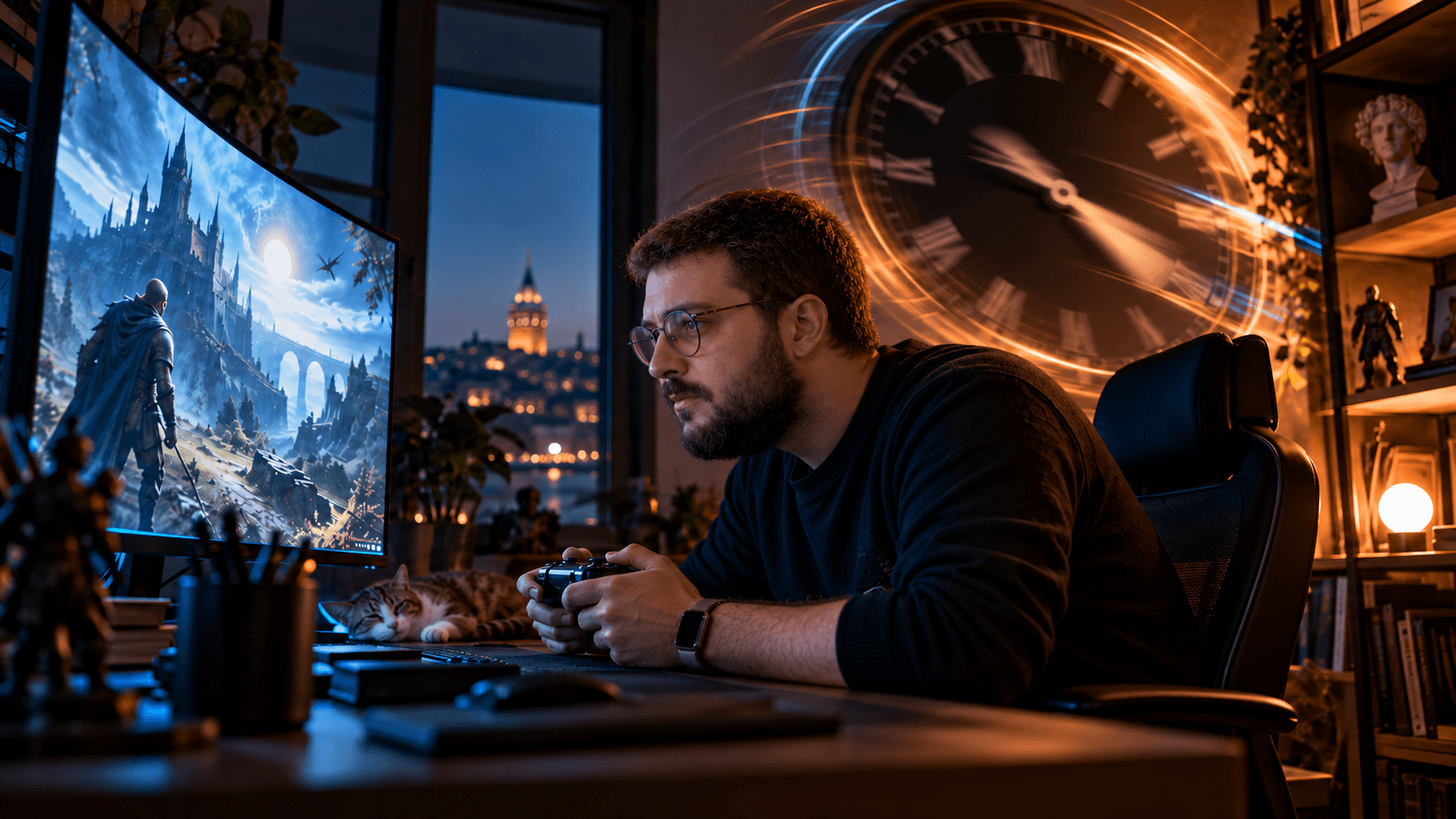
Sometimes you begin doing something and, when you look at the clock, realize that several hours have passed.
While playing a game.
While reading a book.
While writing something.
While taking a photograph.
Sometimes even while working...
Sounds from outside seem to recede, you focus on what you are doing, and time feels as though it is no longer moving at its usual pace but flowing faster.
There is a concept I am particularly fond of in psychology for explaining this experience: flow.
Introduced into the psychology literature through the work of Mihaly Csikszentmihalyi, flow can be understood, in its simplest form, as an experience in which a person becomes deeply involved in an activity, finds an appropriate balance between their skills and the challenge before them, and experiences the activity as rewarding in itself.
It sounds quite positive.
Most of the time, it is.
But there is another question that especially interests me:
When does becoming absorbed in something count as flow, and when can it become problematic use or even addiction?
From the outside, the two experiences can look surprisingly similar.
Where time disappears
One of the most striking features of flow is the change it produces in our perception of time.
Hours can feel like minutes.
A person's entire attention becomes concentrated on the activity. They know what they need to do, receive feedback about what they are doing, and face a challenge that is neither far below nor far above their level of skill.
A task that is too easy can become boring.
A task that is too difficult can create anxiety.
When skill and challenge are appropriately balanced, however, people can become absorbed in what they are doing.
I find this especially useful for understanding digital games.
If a game is so difficult that it makes you fail constantly, you will eventually stop playing because, once the challenge far exceeds your abilities, the experience begins to produce anxiety rather than enjoyment.
If it is so easy that it requires no effort, you will become bored again.
A well-designed game keeps you right at the boundary. This balance often lies behind successful digital games.
You struggle a little, but you succeed.
Then the game becomes a little more difficult.
And you become a little better.
Classes work a little like this too: concepts are explained first, and the subject gradually becomes deeper.
But is ‘I lost track of time’ enough?
This is where things become more complicated.
You may hear the same sentence from someone who has spent two hours watching short videos on social media:
‘I had no idea where the time went.’
Is that flow too?
For many years, flow was discussed mainly alongside positive concepts such as optimal experience, intrinsic motivation, achievement, and well-being.
Digital environments, however, have begun to change this discussion.
A study published in 2026 draws attention to a different experience on short-video platforms that can be described as ‘passive flow’. Here, the user is not performing an activity that requires a high level of skill. There may not even be a meaningful challenge to overcome.
Scrolling is enough.
You simply move your finger.
One video appears.
Then another.
And another...
Even so, your attention remains inside and your perception of time can change markedly.
I find this very important.
Seen this way, simply saying ‘I got absorbed’ is not enough to conclude that the experience was a healthy state of flow.
Flow and addiction are not the same thing
We need to avoid confusing these concepts.
Playing a game with great enjoyment for three hours does not automatically make you addicted to games.
Nor does becoming absorbed in a book and reading until morning mean that you are addicted to books.
When we evaluate addiction, we do not look only at the amount of time spent. Time can certainly be considered, but it does not demonstrate addiction by itself.
Is there a loss of control?
Does the behavior take priority over other areas of the person's life?
Are work, education, relationships, or daily responsibilities being harmed?
Does the person persist in the behavior despite its negative consequences?
The World Health Organization's description of gaming disorder likewise identifies impaired control, the increasing priority given to gaming over other areas of life, and the continuation of gaming despite negative consequences as central features.
I think one of the most important differences between flow and addiction emerges here.
In flow, a person enters into an activity.
In addiction, the activity begins to enter too deeply into the person's life.
They are not the same thing.
But it is not easy to say that they are entirely independent of one another either.
Why does the boundary blur in digital games?
Digital game studies are particularly interesting from this perspective.
Yet I do not think we address the grey area between flow and problematic use as often as it deserves.
Digital games are exceptionally suitable environments for producing flow.
There are clear goals.
There is immediate feedback.
There is skill development.
There is increasing difficulty.
There is a sense of achievement.
There is competition.
And there is often a strong sense of control.
Almost all of these are highly favorable conditions for flow.
Research also shows that flow experiences can be related to problematic gaming behaviors.
Indeed, recent studies show that flow during gaming and symptoms of problematic gaming are distinct structures that nevertheless intersect at certain points.
Processes such as altered time perception and loss of control may be among the points at which these two experiences move closer together.
But there is a small and important detail:
A relationship does not mean equivalence.
Experiencing flow does not mean being addicted.
That is why a claim such as ‘If a game draws you in, it must be addictive’ feels too easy to me.
When we call every form of intensive use addiction, I think we gradually empty the concept of addiction of its meaning.
The real issue is the degree of control the person retains over the experience.
Who is in control?
Perhaps the essay's central question begins here.
In flow, a person may become lost in what they are doing, but they usually still have some form of control in their relationship with the activity.
In problematic use, this balance can be disrupted.
‘One more level.’
‘One more video.’
‘I'll check this and then leave.’
If ending the behavior becomes increasingly difficult, speaking only of flow is insufficient.
Algorithmic content systems introduce another problem.
In classical flow, a person usually develops a skill.
They play an instrument.
They practice a sport.
They play a game.
They produce something.
In a short-video feed, however, the system often optimizes not the balance between skill and challenge but the continuity of attention.
We should not treat these as though they were the same psychological experience.
Not every form of concentration is good
I think flow has been somewhat romanticized in popular psychology.
‘Get into flow.’
‘Reach the flow state.’
‘Be more productive.’
‘Focus.’
It has almost become a personal-development prescription, and my students know very well how I approach the personal-development industry.
As is often the case with psychological concepts, context matters here too.
Forgetting time while practicing the piano for three hours may share some surface similarities with spending three hours watching videos you cannot even remember why you watched.
But I find the claim that these are truly the same experience highly debatable.
In both cases, time may feel as though it passed quickly.
In both cases, your attention to the outside world may diminish.
But one may involve active participation, the use of skill, purpose, and control, while the other may involve far more passive consumption.
Perhaps, then, we should not ask only:
‘How absorbed did I become?’
We should also ask:
‘What did I become absorbed in?’
Can flow have a dark side?
If we see flow as an entirely positive experience, we may struggle to explain some forms of digital use.
Technology companies possess increasingly sophisticated design and personalization tools for sustaining human attention.
Content is personalized.
Its order is continuously adjusted.
Rewards are distributed.
Fresh stimuli are always ready.
The next piece of content arrives before you have a chance to become bored.
In such an environment, remaining intensely engaged does not necessarily constitute an optimal psychological experience in itself.
Sometimes the system simply leaves no natural reason to exit.
At this point, flow connects with the questions of the attention economy and digital design that I have discussed before.
Does a person flow into an activity?
Or does the system make the person's attention flow?
I think the difference matters.
We end up in the same place again: the function of behavior
In psychology, evaluating a behavior only by its duration is often inadequate.
This is true for digital gaming.
For social media.
For phone use.
And for flow.
A person may spend hours doing something and emerge feeling better, more competent, and more fulfilled.
Another person may spend the same amount of time and be unable to explain exactly why they remained there.
From the outside, both may appear to have become absorbed.
Psychologically, however, they may not be in the same place.
Perhaps the following questions are more valuable than measuring time when we try to understand the line between flow and addiction:
Am I still in control?
What does this behavior give me?
Can I stop when I want to?
And how do I feel when it is over?
Becoming absorbed in something is not always bad.
Some of the most beautiful moments in our lives are experienced in exactly this way.
A game.
A book.
A conversation.
A piece of work.
Music.
Time passes and we do not notice.
But perhaps what matters is not that we fail to notice how time passes.
It is what we do within that time and what remains of us when we emerge from it.
Share this article
References
- Peifer, C., Wolters, G., Harmat, L., et al. (2022). A scoping review of flow research. Frontiers in Psychology, 13, 815665. https://doi.org/10.3389/fpsyg.2022.815665
- Wang, N., Ma, L., & Lee, C. S. (2026). The dark side of flow: Passive flow state, metacognitive bias, and compulsive use of short-form videos. Cyberpsychology, Behavior, and Social Networking. https://doi.org/10.1177/21522715261479173
- Burleigh, T. L., Footitt, T., Colder Carras, M., Conkey-Morrison, C., Poulus, D. R., & Stavropoulos, V. (2025). Flowing in the net of disordered gaming: A network analysis approach. Addictive Behaviors Reports, 21, 100606. https://doi.org/10.1016/j.abrep.2025.100606
- World Health Organization. (2020). Addictive behaviours: Gaming disorder. https://www.who.int/news-room/questions-and-answers/item/addictive-behaviours-gaming-disorder